Advancing Wildlife Conservation Through Drone Technology
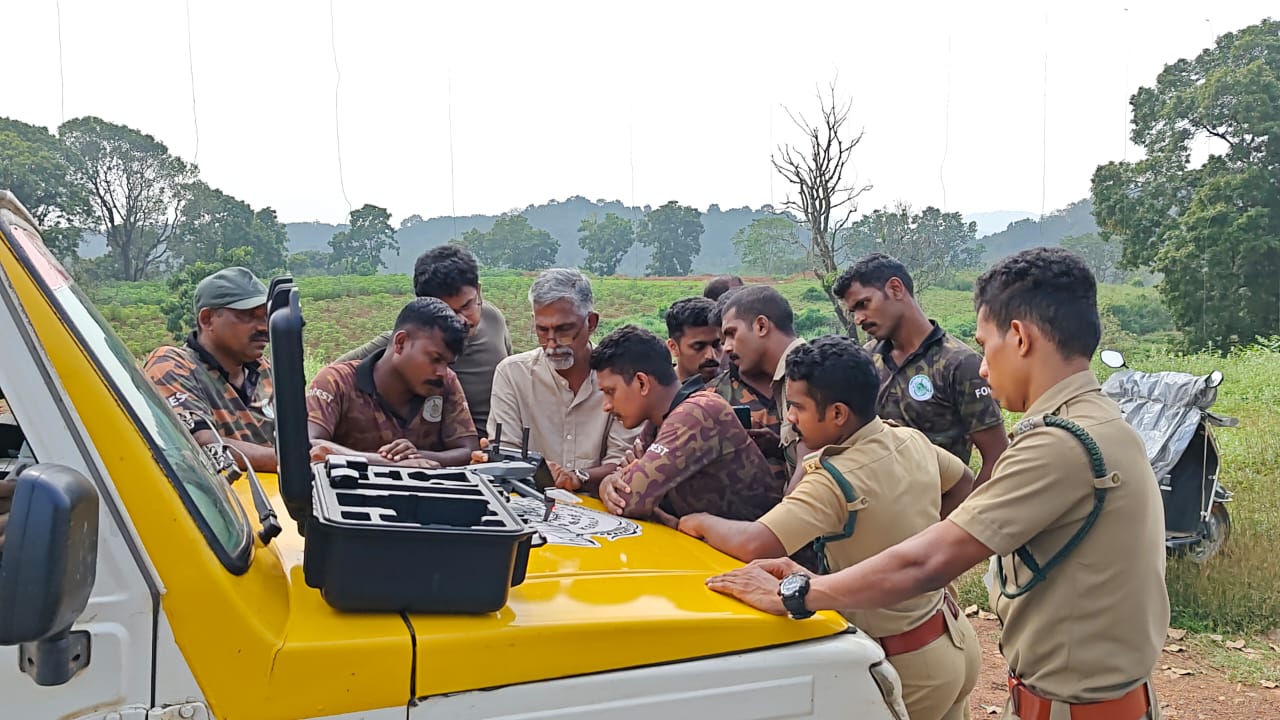
Training Session with Kerala Forest Department’s Rapid Rescue Team
We recently had the privilege of conducting specialized training for the Rapid Rescue Team at Kerala’s Aralam Wildlife Division, Kannur. This initiative focused on deploying the DJI Mavic 3 Thermal Drone – a game-changing tool for wildlife detection and rescue operations in challenging forest terrains.
Key Training Components
- Precision Mission Planning
- Mapping & Waypoint Navigation: Enabled teams to design systematic flight paths covering 15+ km² of dense forest in a single 45-minute session14
- Linear Tracking Protocols: Implemented specialized flight patterns to monitor elephant migration corridors and identify herd movements in real-time
- Advanced Imaging Techniques
- Thermal Analysis Mastery: Leveraged the drone’s 640×512 px radiometric thermal sensor to detect animals through vegetation (detection range: 40-200m)8
- Night Operations: Demonstrated thermal imaging’s superiority in nocturnal wildlife monitoring, where ambient heat signatures stand out clearly68
- Data-Driven Conservation Tools
- Photogrammetry Workflows: Created centimeter-accurate 3D terrain models for habitat analysis using the 20MP visual camera5
- Multi-Sensor Integration: Combined thermal data with RGB imagery through DJI Pilot 2 software for comprehensive situational analysis14
Technology in Action
The Mavic 3 Thermal’s capabilities proved particularly effective for:
- Hidden Animal Detection: Locating species concealed in dense canopy cover (successfully demonstrated in koala conservation projects6)
- Risk-Free Monitoring: Conducting observations from 120m altitude to avoid disturbing sensitive wildlife6
- Rapid Response Coordination: Streaming real-time thermal feeds to ground teams via DJI FlightHub 2 platform14
Operational Impact
This training aligns with global best practices in conservation technology, mirroring successful deployments:
- 63% faster response times in Australian wildfire rescues using similar thermal protocols6
- 40% improvement in detection accuracy compared to traditional spotlight surveys8
Why This Matters
As demonstrated in polar bear den monitoring6 and Kenyan anti-poaching operations, thermal drones are revolutionizing wildlife management. Our session equipped the Kerala team with:
- Enhanced night operation capabilities
- Data collection methods for long-term habitat studies
- Immediate implementation protocols validated by IUCN conservation guidelines
“The integration of thermal imaging with AI-powered analysis represents a paradigm shift in how we protect endangered species.” – Wildlife Technology Institute Report 2024
This collaboration underscores our commitment to bridging cutting-edge technology with ecological preservation. We’re eager to support more agencies in adopting these vital 21st-century conservation tools.
Equipment Specs Highlight:
DJI Mavic 3 Thermal | 45-min flight time | 56x hybrid zoom | AES-256 encrypted data | -20°C to 50°C operational range15